Study in South Korea for Pakistani Students - Edworld

Box 1

Text box description goes here

Study in South Korea for Pakistani Students

Build your Korea study plan with research universities, technology-focused degrees, Korean and English-taught programmes, scholarship options and clear D-2 student visa guidance.

Universities

  • Location: Seoul & Yongin, South Korea
  • Country: South Korea
  • Official Website: khu.ac.kr
  • Location: Ulsan, South Korea
  • Country: South Korea
  • Official Website: unist.ac.kr
  • Location: Seoul, South Korea
  • Country: South Korea
  • Official Website: hanyang.ac.kr

Partner Universities
Why Study in South Korea

Edworld helps students shortlist Korean universities according to academic marks, English/Korean language level, scholarship chances, tuition budget and visa file strength. Students should not select a Korean university only because it is popular; programme language, admission deadline, required documents, dormitory cost and visa readiness matter equally.
Top universities: Seoul National University, KAIST, Yonsei University, Korea University, POSTECH, Sungkyunkwan University and Hanyang University are internationally recognised.
 
Technology advantage: Korea is strong in semiconductors, electronics, AI, robotics, automotive, gaming, media, biotechnology and advanced manufacturing.
 
English-taught options: Many universities offer English-taught graduate programmes; bachelor students should check programme language carefully because some courses require Korean.
 
Scholarship pathway: Global Korea Scholarship and university scholarships can reduce tuition and living cost, but selection is competitive and document quality matters.
 
Student cities: Seoul, Daejeon, Busan, Pohang and Suwon offer different combinations of cost, research access, internships and student lifestyle.
 
Best fit: Korea suits students who can handle competitive academics, language adaptation and deadline-driven applications.
Bachelor’s: HSSC, A Levels, IB or equivalent qualification accepted by the university; competitive universities may require strong grades and extra documents.
 
Master’s: Relevant bachelor’s degree, transcripts, CV, statement of purpose, recommendation letters and sometimes research proposal or portfolio.
 
Language: English-taught programmes may accept IELTS, TOEFL, PTE or university alternatives. Korean-taught programmes usually require TOPIK.
 
Documents: Passport, academic records, apostille/attestation where required, financial proof, admission letter and visa documents must match exactly.
 
Application warning: Korean universities often run strict spring/fall deadlines; late documents can push students to the next intake.
Tuition planning: Public and private university fees vary widely by degree and subject; engineering, business and graduate programmes can cost more than humanities.
 
Living cost: Seoul is usually more expensive than regional cities. Dormitory availability can reduce accommodation cost but must be booked early.
 
Extra costs: Students should budget for application fees, document legalization, visa fee, flight, health insurance, dormitory deposit, local transport and winter clothing.
 
Scholarship effect: GKS and university scholarships can reduce cost significantly, but students must still prepare a realistic self-funded backup plan.
 
Edworld check: We compare tuition, city cost and scholarship probability before recommending a university list.
Part-time work: International students normally need permission before part-time work; allowed hours depend on visa type, study level and Korean language/academic status.
 
Language reality: Korean language ability strongly affects part-time job and internship access outside English-speaking research or tech environments.
 
Graduate options: Students may explore job-seeking or work visa routes after graduation if they meet Korean immigration and employer requirements.
 
Practical warning: Do not plan Korea only on expected part-time income; visa approval and first-year settlement require funds before travel.

Top Universities to Study in South Korea/span>

Korea has several globally ranked universities. Use rankings as one factor alongside programme language, tuition, scholarship fit, city, dormitory and visa file strength.
InstitutionRanking / Recognition 2026
Seoul National UniversityQS WUR 2026: #38
KAIST - Korea Advanced Institute of Science & TechnologyQS WUR 2026: #56
Yonsei UniversityQS WUR 2026: #50
Korea UniversityQS WUR 2026: #61
POSTECHQS WUR 2026: #86
Sungkyunkwan UniversityQS WUR 2026: #126
Hanyang UniversityQS WUR 2026: #159
UNISTTHE WUR 2026: top 201-250 global band
Kyung Hee UniversityQS WUR 2026: #331

Courses to Study in South Korea

– Computer Science
– Artificial Intelligence
– Robotics
– Electrical and Electronic Engineering
– Mechanical Engineering
– Automotive Engineering
– Data Science
– Cyber Security
– Biotechnology
– Business Administration
– International Business
– Korean Language and Culture
– Media and Communication
– Game Design
– Fashion and Design
– Public Policy

Visa Guide to Study in South Korea

Pakistani students usually apply for a Korean student visa after admission. The correct visa depends on the study type and length.
Type of VisaPurposeWhen to ApplyArrival in South Korea
D-2 Student VisaFor degree study at a Korean university, including undergraduate, master's, doctoral and exchange programmes where the institution issues admission documents.Apply after receiving university admission and the required visa documents. Start early because embassy requirements, financial documents and legalization can take time.Travel according to the visa validity and university reporting schedule. Students must follow immigration registration rules after arrival.
D-4 General Training / Korean Language TrainingFor Korean language programmes or non-degree training at eligible institutions. This is not the same as a full degree visa.Apply after acceptance by the language or training institution and after preparing financial and identity documents.Arrival depends on programme start date and visa validity. Students should confirm whether later conversion to degree study is possible before choosing this route.

Scholarship Guide - Study in South Korea

South Korea has strong scholarship options, but most are competitive and deadline-sensitive. Pakistani students should prepare transcripts, recommendation letters, personal statement, study plan, research proposal where required and language evidence before the scholarship window opens.

Global Korea Scholarship (GKS)

GKS is the main Korean government scholarship for international students. It can support undergraduate and graduate study and may include tuition, airfare, settlement support, monthly allowance, Korean language training and insurance depending on the annual call. Students must follow either the embassy track or university track and cannot treat the scholarship as guaranteed. A strong academic record, clear study plan and complete documents are essential.
Colorful dot illustration representing concepts in geometry and mathematics for educational purposes.
Divider graphic illustrating separation concepts in educational materials.

Seoul National University Scholarships

SNU offers several international scholarship routes for admitted students, including graduate and university-administered awards. Coverage and eligibility vary by college, programme and annual budget. Students applying for research degrees should align their SOP, supervisor interest and academic background carefully. Applicants must check each programme’s official scholarship page because deadlines can differ from admission deadlines.
Colorful dot illustration representing concepts in geometry and mathematics for educational purposes.
Divider graphic illustrating separation concepts in educational materials.

Korea University / POSTECH University Funding

Korea University and POSTECH offer university-based funding for selected international students, especially at graduate level. These awards often depend on academic strength, department recommendation, research fit and available professor funding. STEM applicants should prepare a focused CV, research interests and supervisor-aligned statement. Students must not assume all admitted students receive funding.
Colorful dot illustration representing concepts in geometry and mathematics for educational purposes.
Divider graphic illustrating separation concepts in educational materials.

KAIST International Student Scholarship

KAIST offers scholarship support for many admitted international students, especially in science, engineering and technology fields. The award can reduce or cover tuition and may include stipend support depending on degree level and admission conditions. Students should prepare strong academic records, research fit and English evidence. Scholarship rules are linked to admission evaluation, so weak programme matching reduces chances.
Colorful dot illustration representing concepts in geometry and mathematics for educational purposes.
Divider graphic illustrating separation concepts in educational materials.

Yonsei University Scholarships

Yonsei offers merit-based and programme-specific scholarships for international students, including support through its international colleges and graduate schools. Awards can be partial or substantial depending on academic performance, programme and continuation requirements. Students should confirm whether the scholarship applies to their chosen campus and degree. Maintaining grades after admission may be required for renewal.
Colorful dot illustration representing concepts in geometry and mathematics for educational purposes.
Divider graphic illustrating separation concepts in educational materials.

Life in South Korea

Success Stories

We have thousands of successful stories of students who have met their dreams of studying abroad in their dream country.

Blog

Read our latest blogs and news related to education abroad.

For most Pakistani students, South Korea’s D-2 (degree) student visa decision depends....

Planning to study in South Korea from Pakistan usually starts with one....
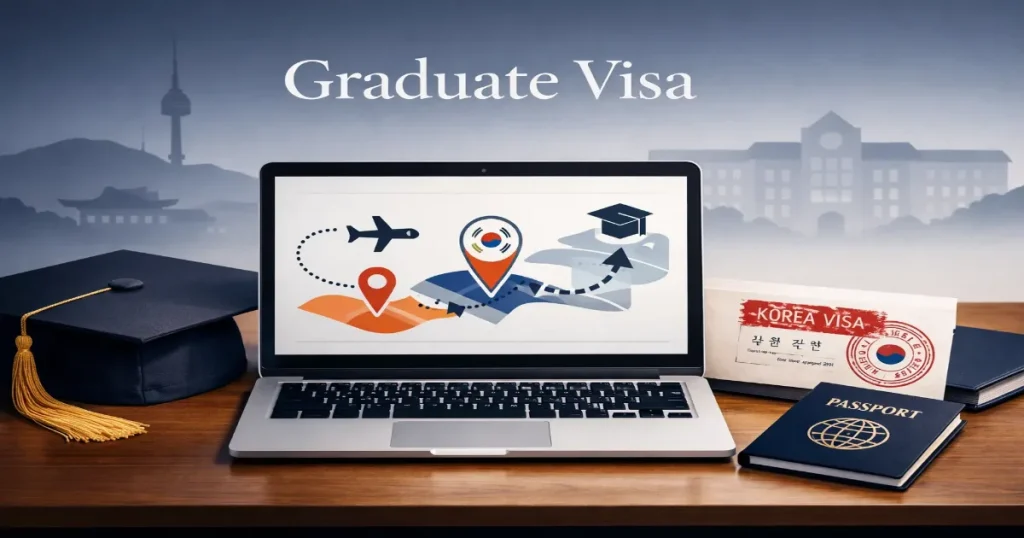
Planning to study in South Korea for a Master’s or PhD is....

FAQ’s

We’ve answered the most common ones to make things simple and clear for you.

01
Can Pakistani students study in South Korea in English?
icon

Yes, many graduate programmes and some undergraduate programmes are taught in English, but programme language must be checked before applying.

02
Is Korean language required?
icon

Not always for English-taught degrees, but Korean language improves daily life, part-time work access and long-term career options.

03
Which visa is needed for Korean university study?
icon

Most degree students apply for the D-2 student visa after admission.

04
Can students work in South Korea?
icon

Students normally need immigration permission for part-time work, and work hours depend on visa/study conditions.

05
Is GKS available for Pakistani students?
icon

Pakistan is usually included in GKS calls, but annual quota, track and eligibility must be checked on official notices.